
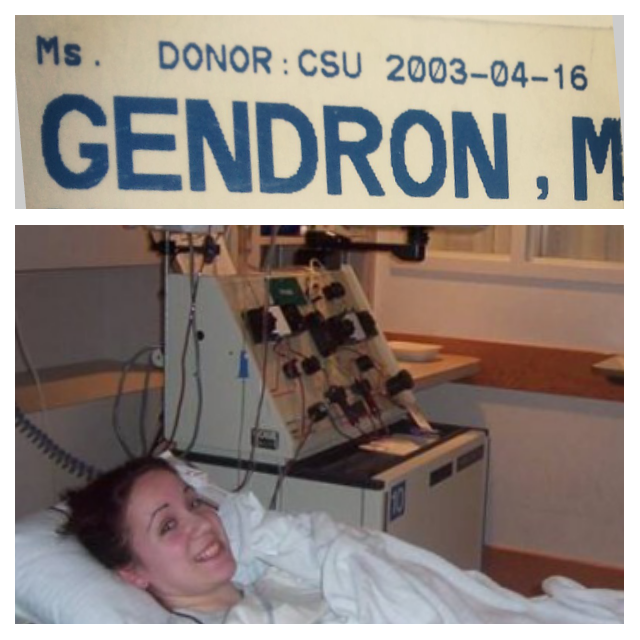
 Today, April 16th 2013, marks the 10 year anniversary of when I went through the procedure to donate bone marrow stem cells. 10 years! I am still wrapping my head around that number, mainly because it still seems like it was only yesterday when it all happened. In honor of this day, I posted a photo to my instagram and facebook of my donor sticker marking the date. I have gotten people messaging me asking about the details of the procedure, what and whom it is actually helping, as well as how to go about signing up. I figured I would take this time to give a brief overview and explanation.
Thousands of people are in need of a donor for a life saving stem cell transplant. Now, what’s a stem cell? Stem cells are Immature cells that can become either red blood cells (which carry oxygen), white blood cells (which fight infection), or platelets (which help to stop bleeding). A wide variety of diseases and disorders are treated with stem cell transplants. Such as: Inherited immune system & metabolic disorders, blood related diseases, and specific cancers such as leukemia, lymphoma, and myeloma.
So what is a stem cell transplant? It’s when a patient’s diseased marrow is replaced with healthy stem cells from a volunteer donor. Stem cells are found in bone marrow and in our peripheral blood, either source may be used for donation. To prepare for the transplant, the recipient is usually given high dose of radiation, or chemotherapy, or both, to destroy the diseased marrow. Donor stem cells are then given intravenously as soon as possible.
The likelihood of a patient finding a compatible donor within their families is about 30%. The other 70% rely on strangers, on people like you who can sign up to be unrelated donors. At any given time there are about 800 Canadians waiting for a match from an unrelated donor. Sadly, only about 2% of our population are registered to do this. And of that 2%, only 18% are from Canada’s many diverse ethnic backgrounds. It’s a renewable resource inside all of us, and yet people are dying because they don’t have a match, you, could be that match.
Joining the registry isn’t hard. You can attend a swabbing event in your city to sign up in person or you can go online and have a registration kit mailed to your house. There’s a knowledge and health questionnaire to fill out, and then a cheek swab. It doesn’t take long, you fill out a form, and then you swab. Pretty simple.
Anyone between the ages of 17 and 50 years old are possible candidates. Certain conditions and diseases will prevent you from being considered a donor: such as: most cancer, heart disease, insulin-dependant diabetes, kidney disease, HIV/AIDS and hepatitis B and C. Joining One match represents a long-term commitment to donate to anyone in need. Not just a friend or relative.
Now, what does it mean to be a match? Stem cell matches are determined according to the compatibility of inherited genetic markers called HUMAN LEUKOCYTE ANTIGENS (HLA), which are inherited from your parents. Up to 12 antigens are considered important in the matching process. The genetic markers used to match donors to patients occur with different frequencies in different ethnic groups. For this reason, a person’s best chance of finding a matching donor is within his or her own ethnic group. It is important to note that your HLA typing is unrelated to your blood type.
If the day comes when you are contacted to be a donor, at that point it is up to you to decide whether you want to proceed to the next step. You are free to decline at any point during the process. However, there is serious risk to the patient if you decide to withdraw after their treatment has begun. You will be informed of when the patient will begin treatment and have every opportunity to decline before that date. When contacted You will have a medical assessment and blood tests to determine the full extent of your compatibility, and you will be informed of which donation process will be used.
There are two ways that the stem cells can be collected: directly from your bone marrow or from your peripheral blood. Nowadays, more than 85% of procedures are done using the peripheral blood technique.
If your stem cell donation process is from bone marrow, you’ll be given general or spinal anesthetic so that you don’t feel anything during the procedure. A needle is inserted into the large bones of your pelvis, not the spine. You can take a mild pain reliever afterwards for any discomfort. The procedure will take 3-5% of your body’s marrow, which will be self replenished within 2-3 weeks.
If your stem cell donation process is from peripheral blood, you will go in prior to your donation day to receive doses of granulocyte colony stimulating factor or G-CSF. Basically what that does is increase your production of stem cells, for example, say your bone marrow is 50% full of stem cells, what the stimulating factor does is increase that to 100%, that way your bones are overflowing with stem cells, and that causes more of them to appear in your peripheral blood. Now the collection process uses this lovely machine called an apheresis machine, and it is closed system for your blood to travel though. You will have a needle inserted, usually in your arm, and it will take your blood into the machine where it is into its components and only the stem cells are removed. The rest of your blood is then put back into your body. This procedure can take anywhere from 2-6 hours, depending on your size and how much is needed for the recipient. I know 6 hours seems like a long time, but you can watch movies while this is happening, so it actually passes pretty quick.
If you cannot donate or are too fearful of the procedures, you can still help! We need more people to be aware of the unrelated donor registry. It is not something you are on automatically; you are not added if you donate blood, you have to specifically sign up.
There is no easier way to help save a life. You don’t have to pay to be a donor, and you don’t have to die. This is something you can do while still maintaining and living your own happy, healthy life.
For more information, check out One Match in Canada. Or organizations such as Gift of Life, Be The Match, or DKMS. There are currently drives happening all over North America for two adorable little girls (Jayden and Sarah) who are both in need of a donor. How can you look at these faces and not help?
 Call me Moni-Q.